Loading
institutionsInstitution

German Cancer Research Center (DKFZ)
The DKFZ is Germany's largest cancer research institute, where Harald zur Hausen linked HPV to cervical cancer (Nobel 2008).
Overview
The German Cancer Research Center, the DKFZ in Heidelberg, is Germany's largest cancer research institute and the place where Harald zur Hausen linked HPV to cervical cancer, work recognised by the Nobel Prize in 2008. It leads the National Center for Tumor Diseases network of university hospitals, produced the CNS tumour DNA methylation classifier and runs cancer prevention research, with Hermann Brenner, Andreas Trumpp, Andreas von Deimling and Michael Baumann among the people OnCo lists. OnCo links it to HPV and HBV vaccination and DNA methylation profiling, to cervical cancer and the paediatric brain tumours ependymoma, ATRT and diffuse midline glioma, to Xilis, and to the idea of machine-readable portfolio reporting for large funders. The valley of death between lab and product is the bottleneck it confronts. Its Heidelberg hospital partner has its own page, as does the German Cancer Consortium (DKTK), the national translational network for which the DKFZ is the core centre.
Location
Heidelberg, DE
Type
research institute
Website
Newsweek 2026 oncology rank
Not in top 300 listing used
OnCo score
#36 · 66 points (0 Newsweek + 0 NCI + 66 from 33 linked objects) · ranking
Research output
From OpenAlex, oncology works in the last five years (2022 to 2026, current year in progress); counted on 2026-09-24.
Matched to German Cancer Research Center, including child institutions. 2,197 works · 32,560 citations · 82% open access · 8% clinical trials · 2% reviews.
Oncology works per year
4812022
5002023
4492024
4202025
3472026
Most works
- Hermann Brenner161 works
- Michael Hoffmeister126 works
- Friedegund Elke Meier69 works
- Dirk Schadendorf66 works
- Karen Steindorf64 works
- Jens Thomas Siveke62 works
- Andreas Schneeweiß57 works
- Jürgen Christian Becker53 works
- Jürgen Weitz50 works
- Thomas Heisser49 works
Most cited

- HPV / prevention
- CNS tumour classification
- NCT network
- DKTK core centre
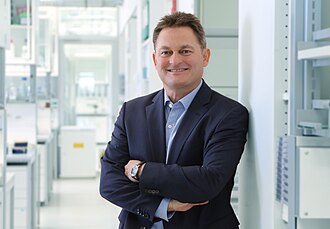
Andreas Trumpp
Head of Stem Cells and Cancer, DKFZ; Managing Director, HI-STEM
Cancer stem cellsMetastasisCirculating tumour cells
Andreas Trumpp is a stem cell biologist studying how dormant cancer cells seed metastases and resist therapy.
Andreas von Deimling
Head of Neuropathology, Heidelberg University Hospital and DKFZ
NeuropathologyBrain tumour classificationDNA methylation profiling
Co-created the DNA methylation classifier that changed how brain tumours are diagnosed worldwide.
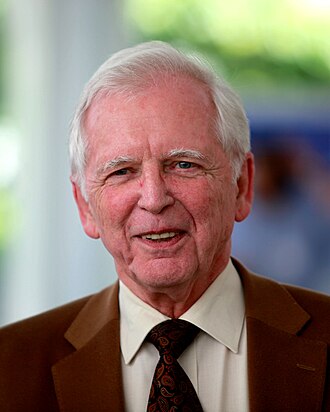
Harald zur Hausen
Virologist who showed that human papillomavirus causes cervical cancer
Tumour virologyHuman papillomavirusCervical cancer
Against the consensus that herpes was to blame, he proposed in 1976 that papillomaviruses cause cervical cancer and isolated HPV16 and HPV18 from tumours in 1983-84, making vaccination and HPV testing possible. Nobel Prize 2008.
Hermann Brenner
Head of Clinical Epidemiology and Aging Research, DKFZ
Cancer epidemiologyColorectal cancer screeningEarly detection
Epidemiologist whose studies underpin colonoscopy and stool-test screening for bowel cancer.
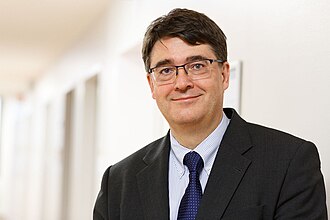
Michael Baumann
Chairman and Scientific Director, German Cancer Research Center (DKFZ)
Radiation oncologyRadiobiologyResearch leadership
Michael Baumann is a radiation oncologist who leads Germany's national cancer research centre.
Stefan Fröhling
Managing Director, NCT Heidelberg; Head of Translational Medical Oncology, DKFZ
Precision oncologySarcomaGenomics-guided trials
Runs the NCT/DKTK MASTER programme that sequences whole genomes of rare and young-adult cancers to guide therapy.

Stefan Pfister
Director, Hopp Children's Cancer Center Heidelberg (KiTZ); Head of Pediatric Neurooncology, DKFZ
Paediatric neuro-oncologyBrain tumour genomicsMolecular classification
Paediatric oncologist whose genomic work redefined childhood brain tumours into molecular subgroups.
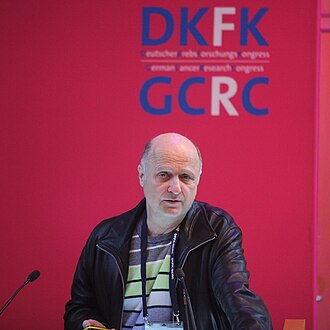
Uwe Haberkorn
Head of Nuclear Medicine, Heidelberg University Hospital and DKFZ
Nuclear medicineFAP-targeted radiopharmaceuticalsTheranostics
Nuclear medicine physician whose group invented FAPI PET tracers and pioneered PSMA and FAP radioligand therapy.
translationalClinical Cancer Research 2020125 citations
First trial of a vaccine against the shared neoantigens of mismatch-repair-deficient cancers
Because Lynch syndrome tumours make the same abnormal proteins in almost every patient, a single vaccine could in principle be given to carriers before cancer develops. This small trial showed the concept is safe and immunogenic; whether it prevents cancer requires the randomised trials now being planned.
translationalCancer Discovery 2018changed practice201 citations
Heining 2018: NRG1 fusions in KRAS wild-type pancreatic cancer
KRAS wild-type status should trigger fusion testing, ideally by RNA sequencing, because NRG1 fusions can be targeted by HER-family inhibitors and now by zenocutuzumab.
Similar pages
- InstitutionDeutsches Netzwerk für Personalisierte Medizin
Shares Stefan Fröhling, Comprehensive Cancer Center Freiburg (CCCF), Comprehensive Cancer Center Tübingen-Stuttgart, nationales Netzwerk Genomische Medizin Lungenkrebs.
- InstitutionCharité Universitätsmedizin Berlin
Shares Deutsche Krebsgesellschaft, Deutsche Krebshilfe, Max Delbrück Center for Molecular Medicine, German Cancer Consortium (DKTK).
- JournalBrain tumor pathology
Shares Ependymoma, Atypical teratoid/rhabdoid tumour (ATRT), Diffuse midline glioma, H3 K27-altered (including DIPG), Glioma & glioblastoma.
- JournalCNS oncology
Shares Ependymoma, Atypical teratoid/rhabdoid tumour (ATRT), Diffuse midline glioma, H3 K27-altered (including DIPG), Glioma & glioblastoma.
- JournalJournal of neuro-oncology
Shares Ependymoma, Atypical teratoid/rhabdoid tumour (ATRT), Diffuse midline glioma, H3 K27-altered (including DIPG), Glioma & glioblastoma.
- InstitutionLMU Klinikum München
Shares Deutsche Krebshilfe, German Cancer Consortium (DKTK), TUM Klinikum rechts der Isar / CCC München.
- InstitutionUniklinik Köln (CIO)
Shares Deutsche Krebshilfe, nationales Netzwerk Genomische Medizin Lungenkrebs, West German Cancer Center (WTZ), University Hospital Essen.
- TechnologyFAPI PET
Shares Uwe Haberkorn, A university cyclotron network with shared regulatory files for new tracers, TUM Klinikum rechts der Isar / CCC München, Heidelberg University Hospital / NCT / DKFZ.
cancers
technologies
companies
institutions
Comprehensive Cancer Center Freiburg (CCCF)Comprehensive Cancer Center Tübingen-StuttgartDeutsche KrebsgesellschaftDeutsche KrebshilfeGemeinsamer Bundesausschuss / IQWiGGerman Cancer Consortium (DKTK)Heidelberg University Hospital / NCT / DKFZMax Delbrück Center for Molecular Medicinenationales Netzwerk Genomische Medizin LungenkrebsNCT/UCC Dresden, University Hospital Carl Gustav CarusTUM Klinikum rechts der Isar / CCC MünchenUniversity Cancer Center Frankfurt (UCT)University Cancer Center Mainz (UCT Mainz) / Universitätsmedizin MainzWest German Cancer Center (WTZ), University Hospital EssenZentrum für Krebsregisterdaten am Robert Koch-Institut
pathways
ideas
collections
people
bottlenecks
key papers
Open-source projects
All open source in oncology →Open-source projects that this organisation maintains, from OnCo's own catalogue: licence and last activity as the repository reported them on the day of the fetch. Listing is not endorsement; check the licence before reuse and the validation before clinical use.
The self-configuring segmentation method from DKFZ that wins most medical segmentation challenges out of the box, including brain, kidney and liver tumour tasks.
DKFZ's Medical Imaging Interaction Toolkit and workbench for segmentation, registration and radiomics applications.
DKFZ's open MATLAB toolkit for radiotherapy treatment planning research: photons, protons, carbon ions, dose calculation and optimisation.
Fast fusion detection from RNA-seq built for clinical use, with a curated list of known cancer fusions and publication-quality plots.
The Python successor to matRad for treatment planning research.
- Brain tumour methylation classifier training codeMITOpen code, closed dataAnalysis pipelines & modelling
The published training code for the Heidelberg DNA methylation-based classification of central nervous system tumours.
Copy-number analysis from DNA methylation arrays, the companion tool of the brain tumour methylation classifier.