Loading
institutionsInstitution

Heidelberg University Hospital / NCT / DKFZ
Heidelberg is Germany's cancer research capital, home to the DKFZ (largest cancer research institute in Germany) and the NCT, and the birthplace of FAPI PET and the brain tumour methylation classifier.
Overview
Heidelberg University Hospital, with the National Center for Tumor Diseases and the German Cancer Research Center (DKFZ), is Germany's cancer research capital and ranks eighteenth in the Newsweek/Statista oncology list. Its record includes the FAPI PET tracers from Haberkorn, Giesel and Kratochwil, the first-in-human actinium-225 PSMA therapy, the Heidelberg Ion-Beam Therapy Center for carbon ions, the DKFZ brain tumour methylation classifier from Pfister and von Deimling, and the MASTER precision oncology programme, with Stefan Fröhling among its leaders. OnCo links it to FAP and PSMA as targets, to SOFIE Biosciences, to the first vaccine trial against shared neoantigens of mismatch-repair-deficient cancers, and to ideas for a university cyclotron network and core-funded radiotherapy trials. Turning tracers into approved therapies at scale is the open problem. The DKFZ has its own page.
Location
Heidelberg, DE
Type
cancer center · Heidelberg University
Website
Newsweek 2026 oncology rank
#18
OnCo score
#18 · 100 points (42 Newsweek + 0 NCI + 58 from 29 linked objects) · ranking
Research output
From OpenAlex, oncology works in the last five years (2022 to 2026, current year in progress); counted on 2026-09-24.
Matched to Heidelberg University, including child institutions. 3,473 works · 46,508 citations · 77% open access · 9% clinical trials · 2% reviews.
Oncology works per year
7582022
7372023
6962024
7212025
5612026
Most works
- Hermann Brenner157 works
- Thilo Hackert139 works
- Michael Hoffmeister124 works
- Markus Wolfgang Büchler79 works
- Jessica Cecile Hassel73 works
- Karen Steindorf65 works
- Andreas Schneeweiß64 works
- Dirk Schadendorf63 works
- Peter Dreger63 works
- Martin Loos61 works
Most cited
- FAPI PET
- Alpha PSMA therapy
- Carbon-ion therapy
- CNS methylation classifier
- DKFZ basic research
Andreas von Deimling
Head of Neuropathology, Heidelberg University Hospital and DKFZ
NeuropathologyBrain tumour classificationDNA methylation profiling
Co-created the DNA methylation classifier that changed how brain tumours are diagnosed worldwide.
Clemens Kratochwil
Nuclear medicine physician, Heidelberg University Hospital
Targeted alpha therapyPSMA radioligandsDosimetry
Clemens Kratochwil reported the first patients treated with actinium-225 PSMA therapy.
Frederik Giesel
Director of Nuclear Medicine, University Hospital Düsseldorf; formerly Heidelberg
Molecular imagingFAPI PETPSMA theranostics
Frederik Giesel co-developed FAPI PET imaging and now leads nuclear medicine in Düsseldorf.
Jürgen Debus
Head of Radiation Oncology, Heidelberg University Hospital; Director, HIT Heidelberg Ion-Beam Therapy Center
Particle therapyCarbon-ion radiotherapyRadiation oncology
Jürgen Debus leads Europe's pioneering heavy-ion therapy centre.
Stefan Fröhling
Managing Director, NCT Heidelberg; Head of Translational Medical Oncology, DKFZ
Precision oncologySarcomaGenomics-guided trials
Runs the NCT/DKTK MASTER programme that sequences whole genomes of rare and young-adult cancers to guide therapy.

Stefan Pfister
Director, Hopp Children's Cancer Center Heidelberg (KiTZ); Head of Pediatric Neurooncology, DKFZ
Paediatric neuro-oncologyBrain tumour genomicsMolecular classification
Paediatric oncologist whose genomic work redefined childhood brain tumours into molecular subgroups.
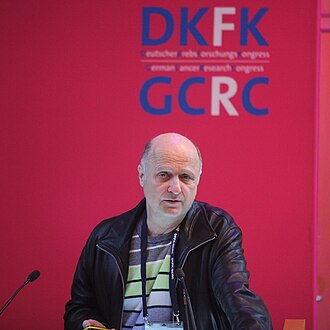
Uwe Haberkorn
Head of Nuclear Medicine, Heidelberg University Hospital and DKFZ
Nuclear medicineFAP-targeted radiopharmaceuticalsTheranostics
Nuclear medicine physician whose group invented FAPI PET tracers and pioneered PSMA and FAP radioligand therapy.
translationalClinical Cancer Research 2020125 citations
First trial of a vaccine against the shared neoantigens of mismatch-repair-deficient cancers
Because Lynch syndrome tumours make the same abnormal proteins in almost every patient, a single vaccine could in principle be given to carriers before cancer develops. This small trial showed the concept is safe and immunogenic; whether it prevents cancer requires the randomised trials now being planned.
translationalCancer Discovery 2018changed practice201 citations
Heining 2018: NRG1 fusions in KRAS wild-type pancreatic cancer
KRAS wild-type status should trigger fusion testing, ideally by RNA sequencing, because NRG1 fusions can be targeted by HER-family inhibitors and now by zenocutuzumab.
Similar pages
- IdeaA regulatory pathway for new radiotherapy techniques modelled on drug development
Shares Jürgen Debus, Core-funded radiotherapy trials infrastructure with central quality assurance, Carbon-ion therapy, MR-guided adaptive radiotherapy.
- PersonKen Herrmann
Shares European Association of Nuclear Medicine, FAPI PET, FAP, PSMA.
- PersonMichael Baumann
Shares Core-funded radiotherapy trials infrastructure with central quality assurance, NCT/UCC Dresden, University Hospital Carl Gustav Carus, German Cancer Research Center (DKFZ), Proton therapy.
- InstitutionEuropean Society for Radiotherapy and Oncology
Shares Jürgen Debus, European Association of Nuclear Medicine, Carbon-ion therapy, MR-guided adaptive radiotherapy.
- InstitutionGemeinsamer Bundesausschuss / IQWiG
Shares Paul-Ehrlich-Institut, Deutsche Krebsgesellschaft, Deutsche Krebshilfe, German Cancer Research Center (DKFZ).
- IdeaFAP theranostics as a pan-cancer stromal strategy
Shares A university cyclotron network with shared regulatory files for new tracers, FAPI PET, FAP, Targeted alpha therapy.
- InstitutionCharité Universitätsmedizin Berlin
Shares Deutsche Krebsgesellschaft, Deutsche Krebshilfe, Deutsches Netzwerk für Personalisierte Medizin, Proton therapy machines: cyclotrons, synchrotrons and single-room systems.
- JournalJournal of Nuclear Medicine
Shares Clemens Kratochwil, Frederik Giesel, Uwe Haberkorn.