Loading
institutionsInstitution

Cold Spring Harbor Laboratory
Basic-science cancer centre where RAS biology, tumour suppressors, and organoid models were advanced.
Overview
Cold Spring Harbor Laboratory in New York is a basic-science cancer centre with NCI basic designation, where RAS biology, tumour suppressors and organoid models were advanced. Its best-known cancer work is David A. Tuveson's pancreatic cancer organoids, Lowe's p53 and senescence biology and Christopher R. Vakoc's BET and SWI/SNF work, with Bruce W. Stillman, Adrian R. Krainer, Tobias Janowitz and Semir Beyaz also listed. OnCo links it to pancreatic ductal adenocarcinoma, to patient-derived organoids and PDAC organoid pharmacotyping, to the autophagy, cachexia, senescence, MYC and TGF-beta pathways, and to the Lustgarten Foundation. Lab models that fail to predict what happens in patients are the bottleneck its organoid work is meant to relieve, and an open organoid bank for rare cancers is one idea it is linked to. Its pancreatic organoid and p53 programmes are listed below.
Location
Cold Spring Harbor, NY, US
Type
research institute
Website
Newsweek 2026 oncology rank
Not in top 300 listing used
NCI designation
basic
OnCo score
#48 · 52 points (0 Newsweek + 8 NCI + 44 from 22 linked objects) · ranking
Research output
From OpenAlex, oncology works in the last five years (2022 to 2026, current year in progress); counted on 2026-09-24.
Matched to Cold Spring Harbor Laboratory, including child institutions. 112 works · 2,178 citations · 75% open access · 7% clinical trials · 3% reviews.
Oncology works per year
232022
282023
222024
192025
202026
Most works
- David A. Tuveson33 works
- Semir Beyaz12 works
- Christopher R. Vakoc12 works
- Charlie Chung9 works
- Jonathan B. Preall9 works
- Corina Amor9 works
- Astrid Deschênes8 works
- Amber N. Habowski8 works
- Daniel A. King8 works
- Scott W. Lowe7 works
Most cited
- Pancreatic organoids
- p53 biology
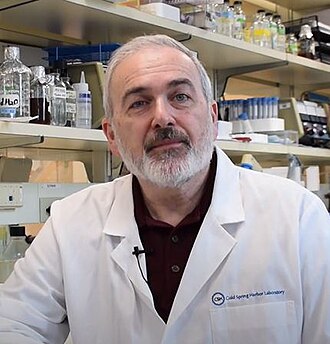
Adrian R. Krainer
St. Giles Foundation Professor
RNA splicingAntisense oligonucleotidesSplicing in cancer
Adrian Krainer invented the antisense drug nusinersen and studies how splicing errors drive cancer.

Bruce W. Stillman
President and Chief Executive Officer
DNA replicationChromatinGenome stability
Bruce Stillman discovered how DNA replication starts, the process cancer cells push into overdrive.
Christopher R. Vakoc
Professor, CSHL Cancer Center
Transcriptional dependenciesBET and chromatin regulatorsCRISPR domain screens
Found that leukaemias depend on the chromatin reader BRD4, launching BET inhibitors, and mapped transcriptional addictions in sarcoma.
David A. Tuveson
Director, CSHL Cancer Center; Roy J. Zuckerberg Professor
Pancreatic cancerOrganoidsTumour stroma
Built the pancreatic cancer organoid models now used to test drugs against a patient's own tumour.
Marc Lustgarten
Cablevision executive whose pancreatic cancer diagnosis launched the Lustgarten Foundation
Pancreatic cancer research fundingPatient-founded foundations
Diagnosed with pancreatic cancer in 1998 at 51, he set up a foundation that awarded ten $100,000 grants in its first year and became the largest private funder of pancreatic cancer research; he died in 1999.
Semir Beyaz
Assistant Professor, CSHL Cancer Center
Diet and cancerIntestinal stem cellsImmunometabolism
Shows how diet reprogrammes intestinal stem cells and immunity to change colorectal cancer risk.
Tobias Janowitz
Associate Professor, CSHL Cancer Center; Medical Oncologist, Northwell Health
Cancer cachexiaWhole-body physiology of cancerPancreatic cancer
Studies how cancer wastes the whole body and how to stop it, one of the field's neglected problems.
translationalNature Genetics 2020591 citations
Transcription phenotypes of pancreatic cancer are driven by genomic events during tumor evolution
It explains why single-sample classifiers disagree on about one tumour in eight and why KRAS allelic imbalance and GATA6 copy number are being read alongside expression.
basicCancer Discovery 20191,938 citations
Cross-species single-cell analysis of pancreatic ductal adenocarcinoma reveals antigen-presenting cancer-associated fibroblasts
Fibroblasts are part of the immune conversation, not just a physical barrier, which is why stromal and immune strategies are now designed together.
basicJournal of Experimental Medicine 20172,243 citations
Distinct populations of inflammatory fibroblasts and myofibroblasts in pancreatic cancer
The myCAF and iCAF distinction is why 'target the stroma' became 'target a fibroblast state', and IL-6 blockade combinations follow from it.
Similar pages
- TermFibroblast subtypes in the pancreatic cancer stroma (myCAF, iCAF and apCAF)
Shares Cross-species single-cell analysis of pancreatic ductal adenocarcinoma reveals antigen-presenting cancer-associated fibroblasts, Distinct populations of inflammatory fibroblasts and myofibroblasts in pancreatic cancer, Tumour microenvironment (TME), Patient-derived organoids.
- IdeaGrow each trial patient's tumour as organoids to decide which platform arm opens next
Shares PDAC organoid pharmacotyping, Patient-derived organoids, Lab models that fail to predict what happens in patients, Pancreatic ductal adenocarcinoma.
- TermDisseminated tumour cells (DTCs)
Shares What decides which disseminated cells ever colonise?, Tumour dormancy, The metastatic cascade.
- TrialPonsegromab phase 2 in cancer cachexia
Shares Treat cachexia before it starts, Cancer cachexia, Pancreatic ductal adenocarcinoma.
- InstitutionStand Up To Cancer
Shares David A. Tuveson, Lustgarten Foundation, Pancreatic ductal adenocarcinoma.
- Key paperMetastatic colonization by circulating tumour cells
Shares What decides which disseminated cells ever colonise?, The metastatic cascade.
- IdeaScore every model system on how well it predicted real trial results
Shares Preclinical results do not reproduce, Patient-derived organoids, Lab models that fail to predict what happens in patients.
- IdeaPre-register animal efficacy studies like clinical trials
Shares Preclinical results do not reproduce, Lab models that fail to predict what happens in patients, National Cancer Institute (NIH).
cancers
technologies
institutions
pathways
ideas
people
bottlenecks
key papers
Cross-species single-cell analysis of pancreatic ductal adenocarcinoma reveals antigen-presenting cancer-associated fibroblastsDistinct populations of inflammatory fibroblasts and myofibroblasts in pancreatic cancerTranscription phenotypes of pancreatic cancer are driven by genomic events during tumor evolution